
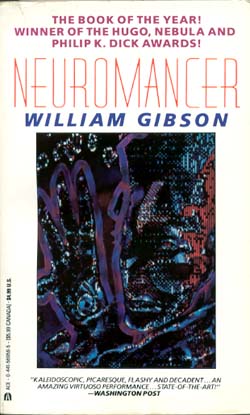
 Very few works can lay claim to launching, at least in the popular
imagination, a new genre, but even as Helen's face launched 1000
ships, Neuromancer gave us cyberpunk. Just don't look this
incarnation of Helen in the eyes; there's no depth there are at all.
Very few works can lay claim to launching, at least in the popular
imagination, a new genre, but even as Helen's face launched 1000
ships, Neuromancer gave us cyberpunk. Just don't look this
incarnation of Helen in the eyes; there's no depth there are at all.
That's right, heresy: William Gibson's Neuromancer is, at least in parts, as thick in plot and characterization as a piece of origami paper.
Bring it on, defenders of the faith.
I'm not saying the novel's all bad, mind you. Gibson has excellent vision, and the set up, the surroundings, the character types, the whole scene is remarkable, breathtaking; that origami folded into a divine shape. But Gibson's problem, in this as in all the novels I've read of his, is endings; everything winds up too easily, too facile-ly, as though the author, having created a living, breathing world, has no idea how to bring his tale to a conclusion and so resorts to the quickest way out of Dodge.
Yet while most novels wouldn't even sell with such a problem, Neuromancer sold millions and won every major award it could find. Why? Is it that this reviewer doesn't know a good novel when he sees it? Defenders of the faith, arise ...
It is possible I don't know what I'm talking about, in which case that English degree was wasted on me, but I think the reason behind Neuromancer's success was that it was the Helen of its world, the book that launched Cyberpunk, the work that became a rallying cry for a new generation. It, like Helen, is part of a mythology, and flaws just don't show up on legends the same as they do on us ordinary folk.
So should you read it? Should you plunk down your money or carte de credit and purchase this first-of-its-kind? If you're into the new mythology, if you're looking for a possible (albeit dark) direction for society in this mixed-up world, then the answer is yes. Resoundingly. I'm merely warning you, as did the serpent:
Don't pry too deeply, or you might disappoint yourself.